
Tekion needed a faster, scalable way to manage permissions across its global team because the existing process was slowing operations, creating inconsistency, and increasing security and compliance risk.
I led the end-to-end design of an internal access control application, collaborating with a Design Manager, Senior Product Manager, Director of Product management and 6 Engineers.
The solution introduced role-based modules, multi-stakeholder approvals, and bulk activation - improving employee productivity while reducing administrative overhead and ensuring consistent access control across all environments.
Key constraints included collaborating across time zones, managing 300+ permission types across 80+ modules, and designing the application from scratch to support a seamless permission workflow.
My Role
Lead UX Designer
My Team
UX Designer, Design Manager, 2 Product Managers, 6 Engineers
Project Timeline
8 Weeks
Fragmented Permission Requests
Teams relied on multiple Slack channels for support, causing lost requests, inconsistent formatting, and missed approvals creating security risks from untracked access changes
Manual Consistency Maintenance
Ensuring uniform bit positions across multiple environments required meticulous manual effort, increasing the risk of configuration errors
Inefficient Environment Syncing
Limited API functionality forced teams to manually sync permissions between environments, creating bottlenecks that delayed deployments
Conducted 22 unmoderated user interviews:
18 virtual Zoom interview sessions (1-hour each)
4 in - person sessions conducted at the office
Each session explored participants' day-to-day interactions with permissions, approval processes, and security concerns.
I analysed competitor approaches to permission management across enterprise platforms. The research identified industry standards for role-based access, approval processes, and bulk operations, providing insights that shaped the application's architecture and user experience.
Archetype 1: Engineers
Request permissions across development, staging, and production environments
Manually coordinate with Product Managers for permission justification
Struggle with unattended support channel requests and delayed approvals


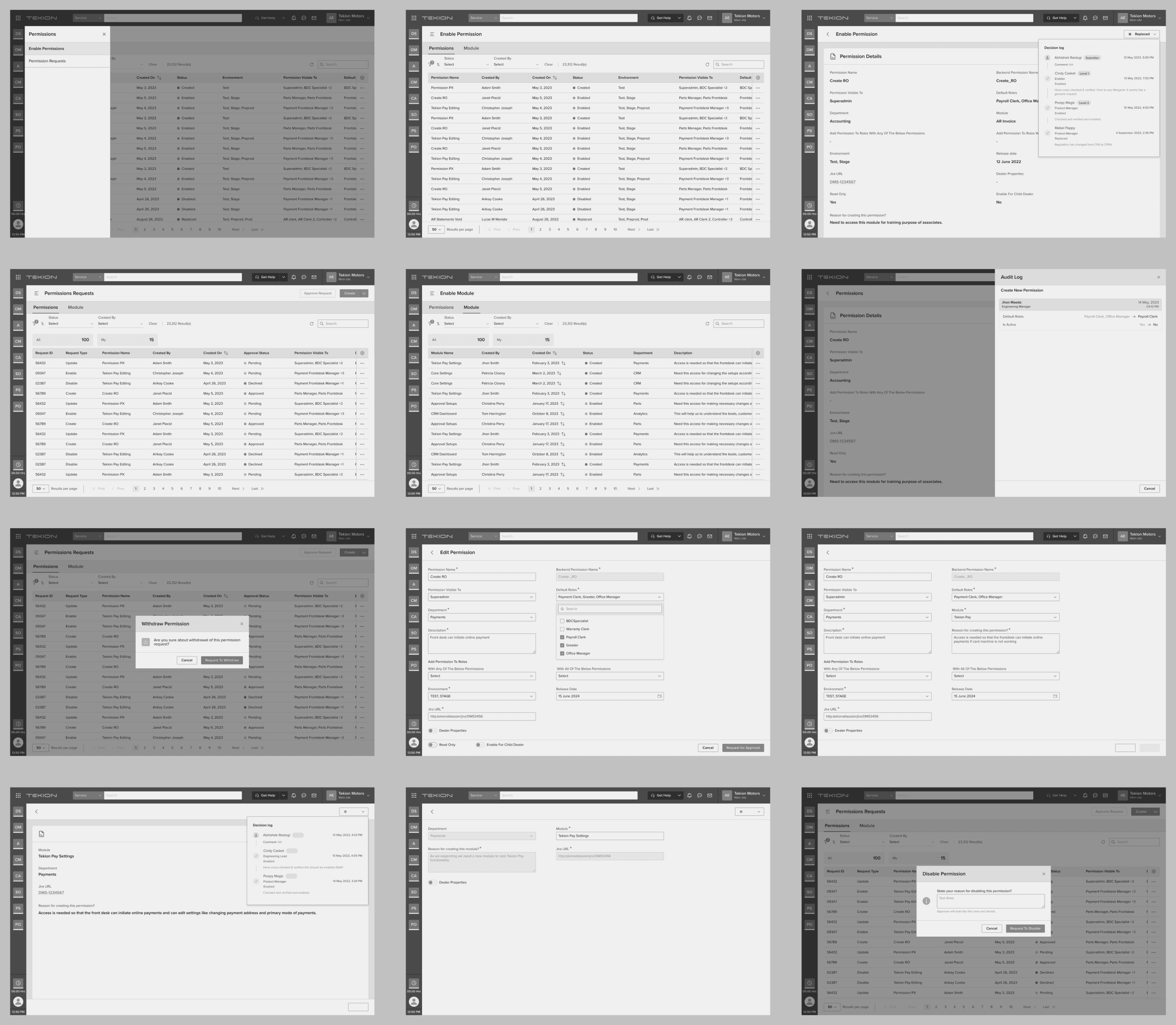
Through in-person moderated testing, I observed participants interact with the prototype while capturing their reactions and behaviours in real-time.
All participants successfully completed their tasks, with high adoption of centralised ticket creation (85%) and approval workflows (100%), demonstrating intuitive design and clear information architecture.


As an Associate Engineer or Engineer, I want to create permission & module request through the app
Create Permission Request
Engineers can create permission tickets directly in the app instead of relying on Slack channels, streamlining requests and eliminating manual back-and-forth with Product Managers.
Create Module Request
Engineers can create module tickets directly in the app instead of coordinating with other engineers through text messages, streamlining the process through a formal approval workflow.

As an Engineering Manager or Product Manager, I need a centralised dashboard to view all permission & module requests, review their details, and approve them efficiently.
Enable Permission Request
Engineering Managers or Product Managers can approve permission requests directly in the app, check all necessary details, and modify bit positions or release dates if needed.
Enable Module Request
Engineering Managers or Product Managers can approve new module requests directly in the app and review all necessary details.
The challenge was eliminating manual Slack coordination and scattered approval processes while maintaining security. The centralised app had to feel intuitive, not complex.
Engineers, Engineering Managers, and Product Managers don't just create tickets—they track requests, coordinate approvals, and need quick status visibility. Features like centralized dashboards, direct ticket creation, and approval workflows respect their workflow reality.
During initial user interviews, we expected certain problems around permission management, but ground reality told a different story. Users faced challenges we never anticipated—like manual coordination across text messages, tracking requests across multiple Slack channels, and lack of real-time status updates. The real problems emerged only through observation, not assumption.